
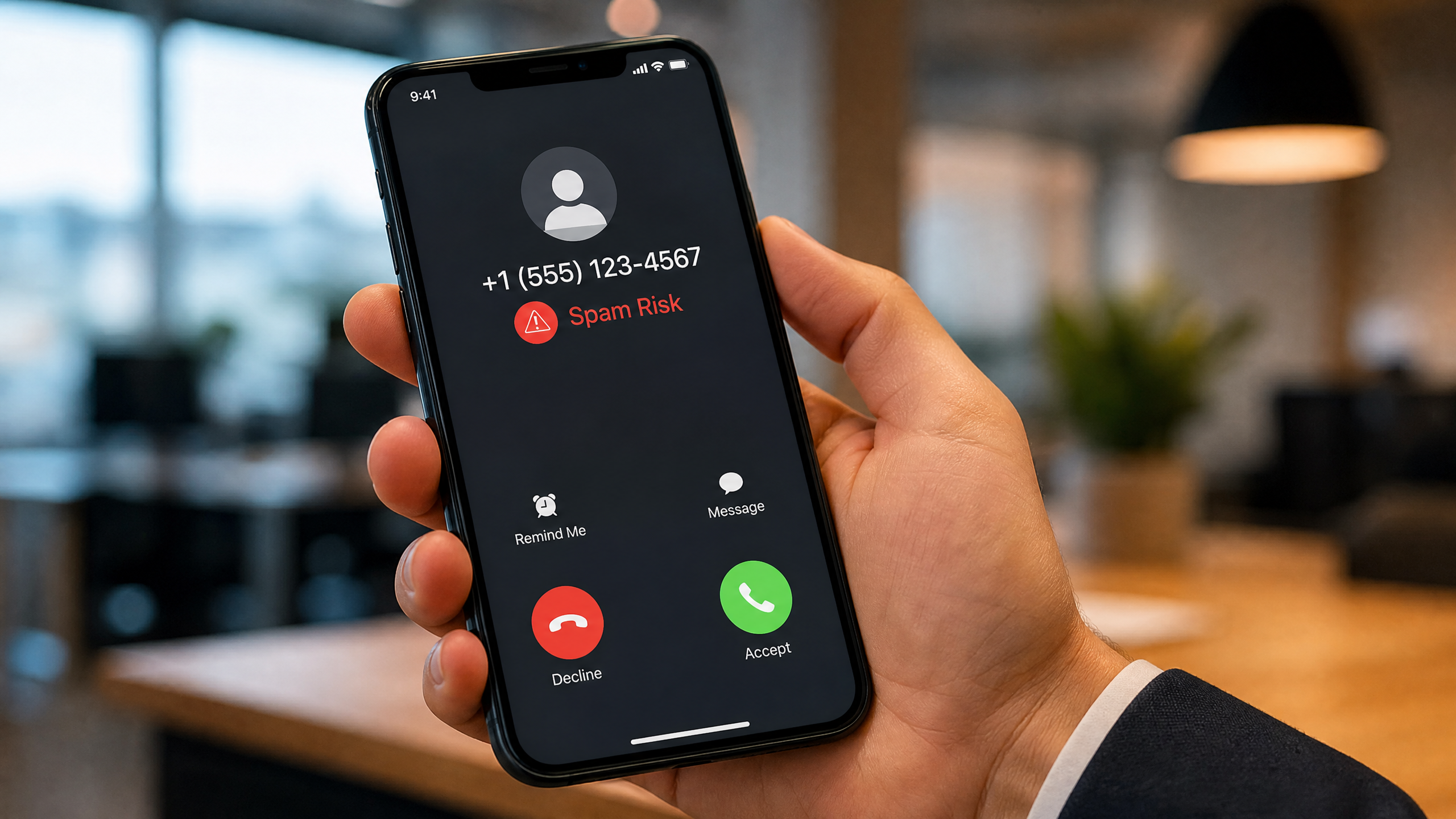
You are calling a customer back about an estimate. They do not pick up. Later they text you: "Sorry, I thought it was spam." That single missed call could have been a $5,000 job. And if your number is labeled "Spam Risk" or "Scam Likely" on your customers's phones right now, this is happening to you every single day — and you probably do not even know it.
Most business owners never find out their number is flagged because customers simply do not call back. They just move on to the next contractor, dentist, or agent who answers with a clean number.
"Spam Risk" vs. "Scam Likely" — They Are Not the Same Thing
These two labels look similar on a phone screen but come from different systems and mean different things for your business:
- "Spam Risk" — Used primarily by AT&T and powered by Hiya. It means the carrier's algorithm has flagged your number based on behavioral patterns: high call volume, low answer rates, or reports from other users. It is a softer warning and is generally easier to resolve.
- "Scam Likely" — Used primarily by T-Mobile and powered by First Orion. This label is more aggressive and typically indicates your number has been reported multiple times or matches patterns associated with fraud. It requires direct action with T-Mobile's Scam Shield program.
- "Fraud Risk" or "Potential Fraud" — Used by Verizon. Similar to Scam Likely in severity. Requires submission through Verizon's official reporting tool.
- "Unknown Caller" or no business name — Not a spam label, but a sign that your CNAM (Caller Name) is not registered. Customers see a number instead of your business name, which causes many to ignore the call.
How to Know If Your Number Is Flagged Right Now
The problem with spam labels is that you cannot see them from your own phone — you only see them from the recipient's side. Here are the most reliable ways to check:
- Call yourself from a friend's AT&T, T-Mobile, and Verizon phone — this covers the three major carriers and takes less than 5 minutes.
- Use YouMail's Robocall Index or Hiya's free lookup tool at hiya.com to check your number's reputation score.
- Ask a recent customer directly — "Did our number show up normally on your phone?" Most will be honest if you ask.
- Check your answer rate trends — if your outbound call answer rate has dropped significantly in the past 30 to 60 days without a clear reason, a spam label is likely the cause.
Why Your Number Gets Flagged Even When You Do Nothing Wrong
This is the part that frustrates most business owners: you can do everything right and still end up flagged. The most common reasons include:
- Recycled number — Your VoIP provider assigned you a number that was previously used by a spammer. You inherited their bad reputation.
- Shared infrastructure — Some low-cost VoIP providers route calls through shared IP addresses or number pools that are already on carrier blacklists.
- Missing STIR/SHAKEN attestation — If your provider does not deliver Attestation A (the highest trust level), your calls arrive with a low-trust signature that triggers spam filters.
- High outbound volume — If your team makes many calls per day, especially follow-up calls that go unanswered, the carrier's algorithm may classify your number as a dialer.
- No CNAM registration — Without a registered business name, your number shows as unknown, which increases the probability of being reported as spam by recipients.
How Zonitel Detects and Resolves Spam Labels
At Zonitel, we have built specific tools and processes to address this problem directly. When you report a spam label — or when our system detects unusual patterns on your number — here is what happens:
- Number Reputation Scan — We run your number through all major carrier databases (Hiya, First Orion, TNS, and Verizon's system) to identify exactly which carriers are flagging you and why.
- Root Cause Analysis — We check whether the issue is a recycled number, a STIR/SHAKEN attestation gap, a CNAM registration problem, or a behavioral pattern from your calling activity.
- Carrier Dispute Submission — We submit formal removal requests on your behalf to the relevant carrier databases. This is not a manual form you fill out — we handle the entire process.
- CNAM Registration Update — If your business name is not showing correctly, we update your CNAM registration across all major databases.
- Number Replacement (if needed) — If the number has a history that cannot be cleared, we provision you a clean replacement number with a verified identity from day one.
In most cases, Zonitel resolves spam label issues within an average of 72 hours from the time we open the dispute. However, resolution time depends on the specific carrier and the severity of the flag — in some cases, particularly with T-Mobile's Scam Likely label or Verizon's Fraud Risk designation, the process can take up to one week. We keep you updated throughout.
What You Can Do While Waiting for the Fix
While the dispute is being processed, there are practical steps to minimize the damage to your business:
- Send a text first — Before calling a prospect or customer, send a brief SMS from your business number: "Hi, this is [Name] from [Company]. I'll be giving you a call in a moment." This primes them to expect and answer your call.
- Reduce outbound call volume temporarily — Avoid making large batches of outbound calls while the dispute is active, as continued high volume can slow down the resolution.
- Use your business name in voicemails — Leave detailed, professional voicemails that clearly identify your company. This helps customers recognize you even if the spam label is still showing.
- Enable SMS follow-up — If a call goes unanswered, Zonitel's Missed Call Text-Back feature automatically sends a text so you stay in contact even when the call is blocked.
The Long-Term Solution: A Phone System Built for Clean Caller ID
The most effective protection against spam labels is not fixing them after they appear — it is preventing them from appearing in the first place. Zonitel is registered in the FCC's Robocall Mitigation Database and delivers STIR/SHAKEN Attestation A on all outbound calls. Every number we provision comes with CNAM registration and is sourced from verified, clean inventory. Your calls arrive with your business name, a verified identity, and the highest trust level the carrier system allows.
Is Your Business Number Showing as Spam?
Contact Zonitel today. We will scan your number across all major carrier databases, identify the problem, and start the resolution process — with an average turnaround of 72 hours.