
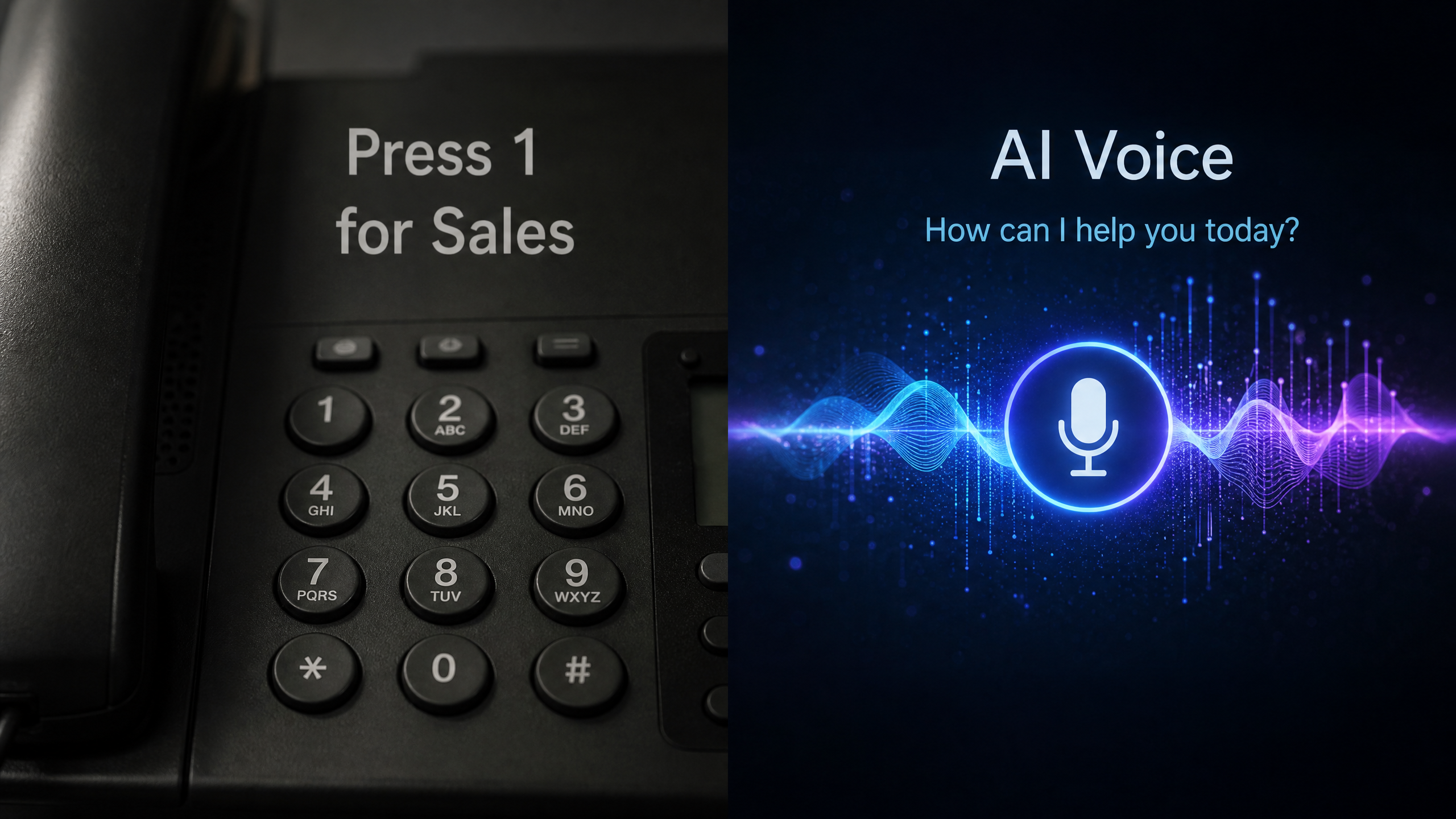
We have all experienced it: "Press 1 for Sales, Press 2 for Support, Press 3 for Billing... Please listen carefully as our menu options have recently changed." Traditional Interactive Voice Response (IVR) systems revolutionized call routing in the 1990s, but in 2026, they are rapidly becoming obsolete.
Enter Voice AI: intelligent, conversational agents that can understand natural language, answer questions, and route calls without a single button press. But is traditional IVR completely dead? Let us compare the two.
Zonitel currently provides traditional IVR and Conversational AI for messaging channels. Real-time AI voice call answering is not currently available from Zonitel.
Traditional IVR: The Reliable Standard
Traditional IVR uses pre-recorded greetings and DTMF (Dual-Tone Multi-Frequency) tones—meaning it reads the numbers you press on your keypad. It is simple, reliable, and highly predictable.
- Pros: Extremely reliable, low cost, easy to set up, perfect for simple routing (e.g., English vs. Spanish).
- Cons: Rigid, frustrating for callers with complex issues, high abandonment rate if the menu is too long.
Voice AI: The Future of Customer Experience
Voice AI uses Natural Language Processing (NLP) to understand what the caller is actually saying. Instead of a menu, the caller hears: "Hi, thanks for calling. How can I help you today?"
- Pros: Natural conversational experience, can answer FAQs without human intervention, routes calls based on context, handles multiple languages dynamically.
- Cons: Requires more setup time to train the AI, slightly higher cost, requires a high-quality VoIP connection.
The Verdict: Which Should You Choose?
If you have a very simple business structure (just a Sales team and a Support team), a well-designed traditional IVR is still highly effective. However, if your staff spends hours answering repetitive questions (hours, location, order status), Voice AI will save you thousands of dollars in labor while providing a better customer experience.
Ready to Upgrade Your Call Routing?
Zonitel currently offers professional IVR and auto-attendant routing for inbound calls, plus Conversational AI for supported messaging channels.